 Home
Home
 Back
Back
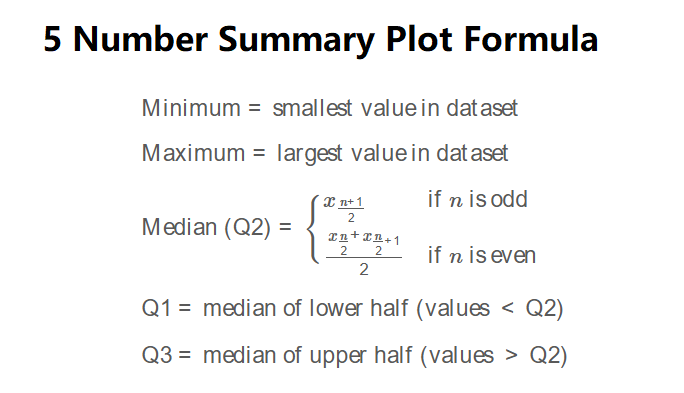
Definition: The 5-Number Summary Calculator computes five key statistics of a dataset: minimum, first quartile (Q1), median (Q2), third quartile (Q3), and maximum. These values provide a concise summary of the data’s distribution, including its range, central tendency, and spread.
Purpose: This tool is used in statistical analysis to summarize datasets, detect outliers, and support visualization through box-and-whisker plots. It’s widely applied in research, education, and data science.
The calculator processes a dataset using the following steps:
Steps:
Formulas:
\( \text{Minimum} = \text{smallest value in dataset} \)
\( \text{Maximum} = \text{largest value in dataset} \)
\( \text{Median (Q2)} = \begin{cases} x_{\frac{n+1}{2}} & \text{if } n \text{ is odd} \\ \frac{x_{\frac{n}{2}} + x_{\frac{n}{2}+1}}{2} & \text{if } n \text{ is even} \end{cases} \)
\( \text{Q1} = \text{median of lower half (values } < \text{Q2)} \)
\( \text{Q3} = \text{median of upper half (values } > \text{Q2)} \)
Where:
The 5-number summary is critical for:
Example: Calculate the 5-number summary for the dataset: 5, 3, 8, 12, 7, 2, 10.
Q: What is a 5-number summary?
A: It’s a set of five statistics (minimum, Q1, median, Q3, maximum) that summarize a dataset’s distribution, useful for understanding spread and central tendency.
Q: How does the median differ from the mean?
A: The median is the middle value in a sorted dataset, more robust to outliers than the mean, which is the arithmetic average.
Q: Why is the 5-number summary useful?
A: It provides a quick, robust summary of data, aids in outlier detection, and supports visualization through box plots, ideal for statistical analysis.