 Home
Home
 Back
Back
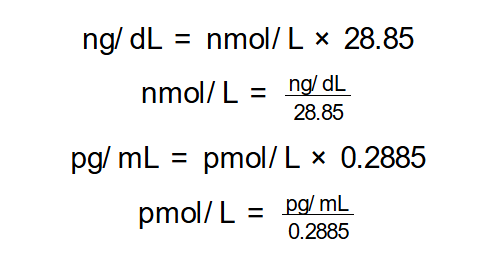
Definition: This calculator converts concentration between nanomoles per liter (nmol/L) and nanograms per deciliter (ng/dL), or between picomoles per liter (pmol/L) and picograms per milliliter (pg/mL), using the conversion factors \( 1 \text{ nmol/L} = 28.85 \text{ ng/dL} \) and \( 1 \text{ pmol/L} = 0.2885 \text{ pg/mL} \).
Purpose: It assists medical professionals, researchers, and students in converting hormone or biomarker concentrations for clinical and laboratory applications.
The calculator uses the equations:
Where:
Steps:
Converting between these units is crucial for:
Example 1: Convert a concentration of \( 100 \, \text{nmol/L} \) to ng/dL:
Example 2: Convert a concentration of \( 1000 \, \text{pmol/L} \) to pg/mL:
Q: What is nmol/L?
A: Nanomoles per liter (nmol/L) is a unit of concentration used for measuring substances like hormones in blood.
Q: What is ng/dL?
A: Nanograms per deciliter (ng/dL) is a unit of concentration commonly used in medical diagnostics, especially in the U.S.
Q: What is pmol/L?
A: Picomoles per liter (pmol/L) is a unit for measuring very low concentrations, often used for specific hormones or biomarkers.
Q: What is pg/mL?
A: Picograms per milliliter (pg/mL) is a unit for measuring low concentrations, commonly used in clinical and research settings.
Q: Why convert between these units?
A: Different labs and regions use different units, so conversion ensures consistency in interpreting test results.
Q: Why must concentration be non-negative?
A: Concentration represents the amount of a substance, which cannot be negative in realistic scenarios.
Q: How accurate are the conversion factors?
A: The factors (28.85 for nmol/L to ng/dL, 0.2885 for pmol/L to pg/mL) are substance-specific and accurate for specific analytes like testosterone.
Q: Can this calculator be used for all substances?
A: No, the conversion factors are specific to certain analytes; check substance-specific guidelines for accuracy.
Q: Why are results sometimes in scientific notation?
A: Results less than 0.001 are shown in scientific notation for readability, per the calculator’s formatting.
Q: Is this calculator useful for medical professionals?
A: Yes, it helps convert lab results for hormones or biomarkers to align with clinical standards or research protocols.
Q: How does this relate to blood tests?
A: Blood tests often report hormone levels in these units, and this calculator standardizes results for comparison.
Q: What are the conversion factors derived from?
A: The factors (28.85 and 0.2885) are based on molecular weights and unit scaling for specific substances, like testosterone.
Q: Can I use this for other concentration units?
A: No, this calculator is specific to nmol/L, ng/dL, pmol/L, and pg/mL; other units require different factors.
Q: Can this be used for pediatric or veterinary medicine?
A: Yes, if the conversion factors apply to the specific analyte being measured in those contexts.
Q: Is this calculator suitable for educational purposes?
A: Yes, it’s ideal for students learning about concentration units in medical or biochemical studies.