Home Back

Sum of Squares Calculator

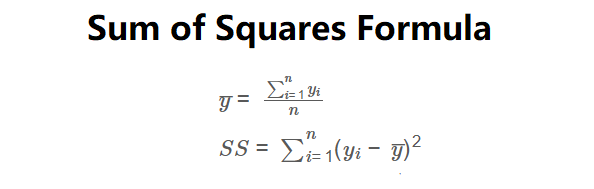
Sum of Squares Formula

1. What is the Sum of Squares Calculator?

Definition: The Sum of Squares Calculator computes the sum of squared deviations (\( SS \)) from the sample mean, which measures the total variability in a dataset.

Purpose: This tool is used in statistics to quantify variability, serving as a building block for variance, standard deviation, and other analyses like ANOVA.

2. How Does the Calculator Work?

The calculator uses the following formulas for a dataset with \( n \) observations:

\( \bar{y} = \frac{\sum_{i=1}^n y_i}{n} \)

\( SS = \sum_{i=1}^n (y_i - \bar{y})^2 \)

Steps:

  • Enter a comma-separated list of numbers (at least 1).
  • Calculate the sample mean (\( \bar{y} \)).
  • Compute the squared difference from the mean for each data point (\( (y_i - \bar{y})^2 \)).
  • Sum the squared differences to get the sum of squares (\( SS \)).
  • Display the sample mean and sum of squares, formatted to four decimal places or scientific notation.

3. Importance of Sum of Squares

The sum of squares is critical for:

  • Variability Measurement: Quantifies the total deviation of data points from the mean.
  • Statistical Analysis: Used in calculating variance, standard deviation, and in techniques like regression and ANOVA.
  • Data Interpretation: Higher values indicate greater variability in the dataset.

4. Using the Calculator

Example: Calculate the sum of squares for the dataset: [20, 22, 18].

  • Input: 20,22,18
  • Sample Mean: \( \bar{y} = (20 + 22 + 18) / 3 = 60 / 3 = 20 \)
  • Squared Differences: \( (20 - 20)^2 = 0 \), \( (22 - 20)^2 = 4 \), \( (18 - 20)^2 = 4 \)
  • Sum of Squares: \( SS = 0 + 4 + 4 = 8 \)
  • Result: Sample Mean: 20.0000, Sum of Squares: 8.0000

5. Frequently Asked Questions (FAQ)

Q: What does the sum of squares represent?
A: It measures the total squared deviation of data points from the mean, indicating dataset variability.

Q: Why is at least one data point required?
A: The sum of squares requires a mean to compute deviations, which can be defined with one data point (though variability is zero in such cases).

Q: How is the sum of squares used in statistics?
A: It’s a key component in calculating variance, standard deviation, and in analyses like regression and ANOVA to assess data spread.

Sum of Squares Calculator© - All Rights Reserved 2025