 Home
Home
 Back
Back
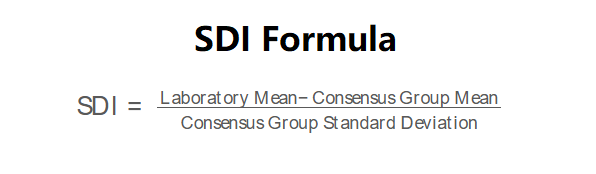
Definition: The Standard Deviation Index (SDI) Calculator computes the SDI, which measures the difference between a laboratory mean and a consensus group mean in terms of the consensus group’s standard deviation.
Purpose: This tool is used in statistics and quality control to assess how far a test model’s mean is from a population mean, aiding in evaluating test accuracy.
The calculator uses the following formula:
\( \text{SDI} = \frac{\text{Laboratory Mean} - \text{Consensus Group Mean}}{\text{Consensus Group Standard Deviation}} \)
Steps:
The SDI is critical for:
Example: Calculate the SDI for a laboratory mean of 9, consensus group mean of 8, and consensus group standard deviation of 2.
Q: What does the SDI indicate?
A: SDI measures how far the laboratory mean is from the consensus group mean in terms of the consensus group’s standard deviation. A positive SDI indicates the laboratory mean is higher; a negative SDI indicates it’s lower.
Q: Why must the standard deviation be positive?
A: The standard deviation is a measure of spread and must be positive to avoid division by zero or negative values in the SDI formula.
Q: How is SDI used in practice?
A: SDI is used in quality control to assess the accuracy of test results, helping to identify biases in laboratory measurements.