 Home
Home
 Back
Back
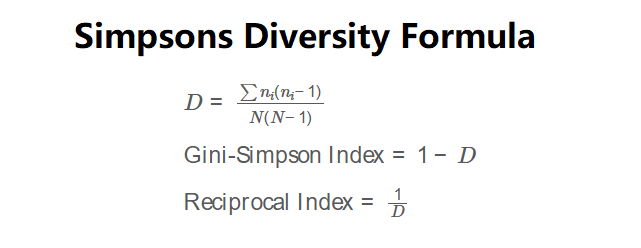
Definition: The Simpson's Diversity Index Calculator computes Simpson's Index (\( D \)), which measures the probability that two randomly selected individuals belong to the same species, the Gini-Simpson Index (\( 1-D \)), which measures the probability they belong to different species, and the Reciprocal Index (\( 1/D \)), which estimates the effective number of species.
Purpose: This tool quantifies biodiversity in ecological communities or diversity in other contexts (e.g., organizational diversity), accounting for both species richness and evenness.
The calculator uses the following formulas for a community with \( N \) total individuals and \( n_i \) individuals per species:
\( D = \frac{\sum n_i (n_i - 1)}{N (N - 1)} \)
\( \text{Gini-Simpson Index} = 1 - D \)
\( \text{Reciprocal Index} = \frac{1}{D} \)
Steps:
Simpson’s indices are critical for:
Example: Calculate Simpson’s indices for species populations: [300, 335, 365].
Q: What does Simpson's Index (\( D \)) represent?
A: It’s the probability that two randomly selected individuals from a community belong to the same species. A higher \( D \) indicates lower diversity.
Q: Why use the Gini-Simpson Index (\( 1-D \))?
A: It measures the probability that two individuals belong to different species, with higher values indicating greater diversity, making it more intuitive.
Q: What is the Reciprocal Index (\( 1/D \))?
A: It estimates the effective number of species, ranging from 1 to the number of species, with higher values indicating greater diversity.