 Home
Home
 Back
Back
Definition: The Percentile Calculator computes the k-th percentile of a dataset, which is the value below which k% of the data points fall when ordered from smallest to largest.
Purpose: This tool is used in statistics to understand the distribution of data, such as identifying thresholds or benchmarks (e.g., the 90th percentile of test scores).
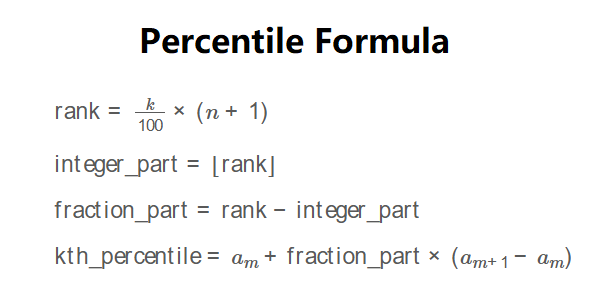
The calculator uses the following steps to compute the k-th percentile:
\( \text{rank} = \frac{k}{100} \times (n + 1) \)
\( \text{integer_part} = \lfloor \text{rank} \rfloor \)
\( \text{fraction_part} = \text{rank} - \text{integer_part} \)
\( \text{kth_percentile} = a_m + \text{fraction_part} \times (a_{m+1} - a_m) \)
where \( a_i \) are the ordered data points, \( n \) is the number of data points, \( m = \text{integer_part} \), and \( k \) is the percentile (0 to 100). The result is formatted to \( \lceil k / 10 \rceil \) decimal places (minimum 1).
Steps:
Percentiles are critical for:
Example: Calculate the 75th percentile for the dataset: [10, 20, 30, 40, 50].
Q: What is a percentile?
A: A percentile is a value below which a given percentage of data points fall in an ordered dataset (e.g., the 50th percentile is the median).
Q: Why is the dataset sorted?
A: Sorting ensures the percentile reflects the correct position in the data distribution, as percentiles are based on ordered values.
Q: How are decimal places determined?
A: The result is formatted to \( \lceil k / 10 \rceil \) decimal places (minimum 1), so k = 75 yields 8 decimal places, k = 25 yields 3, etc.