Home Back

Chi-Square Calculator

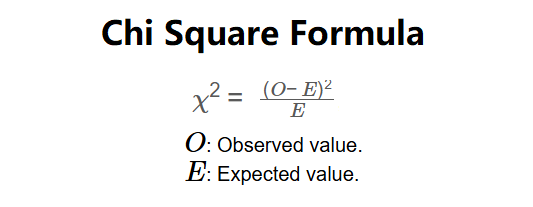
Chi-Square Formula

1. What is the Chi-Square Test?

Definition: The chi-square test is a statistical method used to compare observed and expected frequencies to determine if there is a significant difference.

Purpose: Commonly used to assess the goodness of fit for a single category or hypothesis.

2. How Does the Calculator Work?

The calculator uses the formula: \( \chi^2 = \frac{(O - E)^2}{E} \), where:

  • \( O \): Observed value.
  • \( E \): Expected value.

Steps:

  • Enter the observed and expected values.
  • Click "Calculate" to compute the chi-square statistic.

3. Why Use the Chi-Square Test?

Useful for:

  • Goodness of Fit: Checking if observed data matches expected outcomes.
  • Quality Control: Validating process consistency.
  • Education: Assessing grading distributions.

4. Using the Calculator

Example:

  • Observed = 5, Expected = 9: \( \chi^2 = \frac{(5 - 9)^2}{9} = \frac{16}{9} \approx 1.7778 \).
  • Observed = 10, Expected = 15: \( \chi^2 = \frac{(10 - 15)^2}{15} = \frac{25}{15} \approx 1.6667 \).

5. Frequently Asked Questions (FAQ)

Q: What if expected value is zero?
A: The calculation is undefined; ensure the expected value is positive.

Q: Is this for multiple categories?
A: This version calculates for one category; use a multi-category version for more complex tests.

Q: How to interpret the result?
A: Compare with a chi-square critical value (e.g., 3.841 for 1 df at 0.05) to assess significance.

Chi-Square Calculator© - All Rights Reserved 2025