Home Back

Central Limit Theorem Calculator

Central Limit Theorem Formula

1. What is the Central Limit Theorem?

Definition: The central limit theorem (CLT) states that the sampling distribution of the sample mean approximates a normal distribution as the sample size becomes large, regardless of the population's distribution shape, provided certain conditions are met.

Purpose: Enables estimation of population parameters from sample statistics and simplifies statistical inference.

2. How Does the Calculator Work?

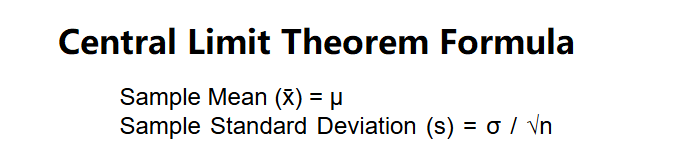
The calculator uses the following formulas:

  • Sample Mean (x̄) = μ: The sample mean equals the population mean.
  • Sample Standard Deviation (s) = σ / √n: The sample standard deviation is the population standard deviation divided by the square root of the sample size.

Steps:

  • Enter the population mean (μ), population standard deviation (σ), and sample size (n).
  • Click "Calculate" to compute the sample mean and sample standard deviation.

3. Why Use the Central Limit Theorem?

Useful for:

  • Statistical Inference: Estimating population means from large samples.
  • Quality Control: Analyzing sample data in manufacturing.
  • Survey Analysis: Generalizing results from sample surveys.

4. Using the Calculator

Example:

  • μ = 60, σ = 15, n = 100: x̄ = 60, s = 15 / √100 = 1.5.
  • μ = 100, σ = 20, n = 400: x̄ = 100, s = 20 / √400 = 1.

5. Frequently Asked Questions (FAQ)

Q: What sample size is large enough?
A: Generally, n ≥ 30 is considered sufficient, though it depends on the population distribution.

Q: Does CLT apply to all distributions?
A: Yes, for large sample sizes, though the population should have a finite variance.

Q: What if σ is unknown?
A: The sample standard deviation (s) from the data can be used as an estimate.

Central Limit Theorem Calculator© - All Rights Reserved 2025