Home Back

Benford's Law Calculator - Leading Digit Probabilities

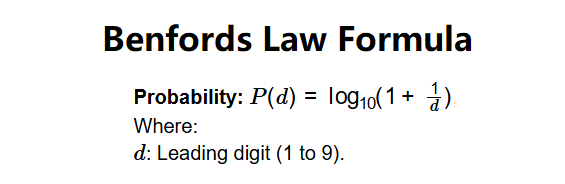
Benford's Law Formula

Non-positive numbers are ignored.

1. What is Benford's Law?

Definition: Benford's Law describes the expected frequency of leading digits in many naturally occurring datasets. It states that the leading digit \( d \) (from 1 to 9) occurs with probability \( P(d) = \log_{10}(1 + \frac{1}{d}) \). This implies that smaller digits (e.g., 1) appear more frequently than larger ones (e.g., 9).

Purpose: It is used to detect anomalies in datasets, such as financial records or scientific data, where deviations from Benford's Law may indicate fraud or errors.

2. How Does the Calculator Work?

The calculator uses the following formula:

  • Probability: \( P(d) = \log_{10}(1 + \frac{1}{d}) \), where \( d \) is the leading digit (1 to 9).
  • Where:
    • \( d \): Leading digit (1 to 9).
    • \( P(d) \): Expected probability of the leading digit being \( d \).

Steps:

  • Enter the sample size (1 to 50); fields update dynamically.
  • Input numbers for the sample; non-positive numbers are ignored.
  • Extract the leading digit of each positive number.
  • Calculate expected probabilities using \( P(d) = \log_{10}(1 + \frac{1}{d}) \).
  • Compute observed frequencies based on input data.
  • Display a table comparing expected probabilities and observed frequencies as percentages.

3. Why Does Benford's Law Hold?

Benford's Law arises because the logarithms of numbers in many datasets are uniformly distributed. The interval \( [\log_{10} d, \log_{10} (d+1)] \) is wider for smaller \( d \), making smaller digits more likely. For example:

  • The interval \( [\log_{10} 1, \log_{10} 2] \approx [0, 0.3010] \) is about 6 times wider than \( [\log_{10} 9, \log_{10} 10] \approx [0.9542, 1] \).
  • Thus, digit 1 appears roughly 6 times more often than digit 9.

4. Importance of Benford's Law

These calculations are key for:

  • Fraud Detection: Identifies irregularities in financial data, tax returns, or election results.
  • Data Analysis: Verifies the integrity of scientific or statistical datasets.
  • Education: Illustrates logarithmic distributions and probability concepts.

5. Using the Calculator

Example:

  • Sample size: 2, Numbers: 123, 456.
  • Leading digits: 1 (from 123), 4 (from 456).
  • Observed frequencies: 50% for 1, 50% for 4 (based on 2 numbers).
  • Expected probabilities: \( P(1) \approx 30.10\% \), \( P(4) \approx 7.92\% \).
  • Result: Table shows expected vs. observed percentages for all digits.

6. Frequently Asked Questions (FAQ)

Q: Why is digit 1 the most common?
A: The logarithmic interval for digit 1 is the widest, making it the most likely leading digit.

Q: Where does Benford's Law apply?
A: It applies to datasets spanning multiple orders of magnitude, like populations, stock prices, or natural measurements.

Q: Can Benford's Law detect all fraud?
A: No, but significant deviations from expected probabilities can flag data for further investigation.

Benford's Law Calculator© - All Rights Reserved 2025