1. What is Delta-V Calculator?
Definition: This calculator computes the change in velocity (\( \Delta v \)) of a rocket using the Tsiolkovsky rocket equation, based on the rocket's exhaust velocity (\( v_e \)) or specific impulse (\( I_{sp} \)), initial mass (\( m_0 \)), and final mass (\( m_f \)).
Purpose: It is used in aerospace engineering to determine the velocity change a rocket can achieve, which is critical for mission planning, such as reaching orbit or performing interplanetary travel.
2. How Does the Calculator Work?
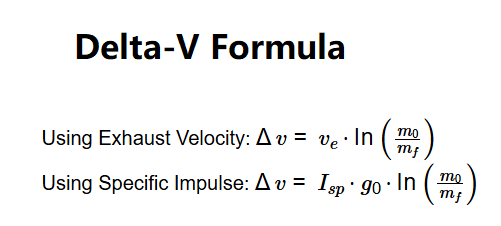
The calculator uses the Tsiolkovsky rocket equation:
Formula:
- Using Exhaust Velocity: \( \Delta v = v_e \cdot \ln \left( \frac{m_0}{m_f} \right) \)
- Using Specific Impulse: \( \Delta v = I_{sp} \cdot g_0 \cdot \ln \left( \frac{m_0}{m_f} \right) \)
Where:
- \( \Delta v \): Change in velocity (m/s)
- \( v_e \): Effective exhaust velocity (m/s)
- \( I_{sp} \): Specific impulse (s)
- \( g_0 \): Standard gravity (\( g_0 = 9.80665 \, \text{m/s}^2 \))
- \( m_0 \): Initial mass (kg)
- \( m_f \): Final mass (kg)
Unit Conversions:
- Exhaust Velocity (\( v_e \)):
- 1 m/s = 1 m/s
- 1 km/s = 1000 m/s
- 1 ft/s = 0.3048 m/s
- Mass (\( m_0 \), \( m_f \)):
- 1 kg = 1 kg
- 1 g = 0.001 kg
- 1 ton = 1000 kg
- 1 lb = 0.453592 kg
- Delta-V (\( \Delta v \)):
- 1 m/s = 1 m/s
- 1 km/s = 0.001 m/s
- 1 ft/s = 3.28084 m/s
Steps:
- Select the input mode (use \( v_e \) or \( I_{sp} \)).
- Enter the exhaust velocity (\( v_e \)) or specific impulse (\( I_{sp} \)), initial mass (\( m_0 \)), and final mass (\( m_f \)) with their respective units.
- Convert all inputs to base units (m/s for velocity, kg for mass).
- Calculate \( \Delta v \) using the Tsiolkovsky rocket equation.
- Convert the result to the selected unit for display.
- Display the result with 4 decimal places.
3. Importance of Delta-V Calculation
Calculating Delta-V is crucial for:
- Mission Planning: Determining the velocity changes required for orbital maneuvers, interplanetary travel, or landing.
- Rocket Design: Estimating the amount of propellant needed to achieve a desired velocity change.
- Space Exploration: Ensuring spacecraft can reach their destinations within the constraints of their propulsion systems.
4. Using the Calculator
Example:
Calculate the Delta-V for a rocket with an exhaust velocity of \( v_e = 3000 \, \text{m/s} \), an initial mass of \( m_0 = 10000 \, \text{kg} \), and a final mass of \( m_f = 4000 \, \text{kg} \).
- Select the input mode as "Use Exhaust Velocity (\( v_e \))".
- Enter \( v_e = 3000 \, \text{m/s} \), \( m_0 = 10000 \, \text{kg} \), and \( m_f = 4000 \, \text{kg} \).
- The calculator computes:
- \( \Delta v = 3000 \cdot \ln \left( \frac{10000}{4000} \right) \approx 3000 \cdot \ln(2.5) \approx 3000 \cdot 0.9163 \approx 2748.8736 \, \text{m/s} \).
5. Frequently Asked Questions (FAQ)
Q: What is Delta-V?
A: Delta-V (\( \Delta v \)) is the change in velocity a rocket can achieve, calculated using the Tsiolkovsky rocket equation, which depends on the exhaust velocity, initial mass, and final mass of the rocket.
Q: What is the Tsiolkovsky rocket equation?
A: The Tsiolkovsky rocket equation relates the change in velocity (\( \Delta v \)) to the exhaust velocity (\( v_e \)) or specific impulse (\( I_{sp} \)) and the mass ratio of the rocket, given by \( \Delta v = v_e \cdot \ln \left( \frac{m_0}{m_f} \right) \).
Q: How does the calculator handle different units?
A: The calculator allows users to input exhaust velocity in m/s, km/s, or ft/s, and masses in kg, g, ton, or lb. It converts all inputs to base units (m/s and kg) for calculation and displays the result in user-selected units (m/s, km/s, ft/s).